How Much Does Shipping Add to a Bag of Coffee? About 21 Cents
First published in our newsletter, What's Brewing, on July 22, 2026. Freight rates and green coffee prices are from that week. The per-pound and per-bag figures were recalculated in September 2026 on a 42,000-pound container and 1.25 pounds of green coffee per pound roasted, the same basis as our carbon footprint piece, so they run a cent or two above the newsletter version.
The short answer: moving a 12-ounce bag's worth of coffee from a port in Indonesia to a rail yard in Chicago costs about 21 cents in ocean and rail freight. That is the whole freight bill, measured in July 2026, after a war had nearly tripled the rate. The increase itself was about 13 cents a bag.
There is a war in the Gulf, the Strait of Hormuz is a mess, and the shipping headlines are ugly. So it is a fair question: is this about to make your coffee more expensive? We did the math on one real container, Sumatra to Chicago.
The route a container of coffee takes
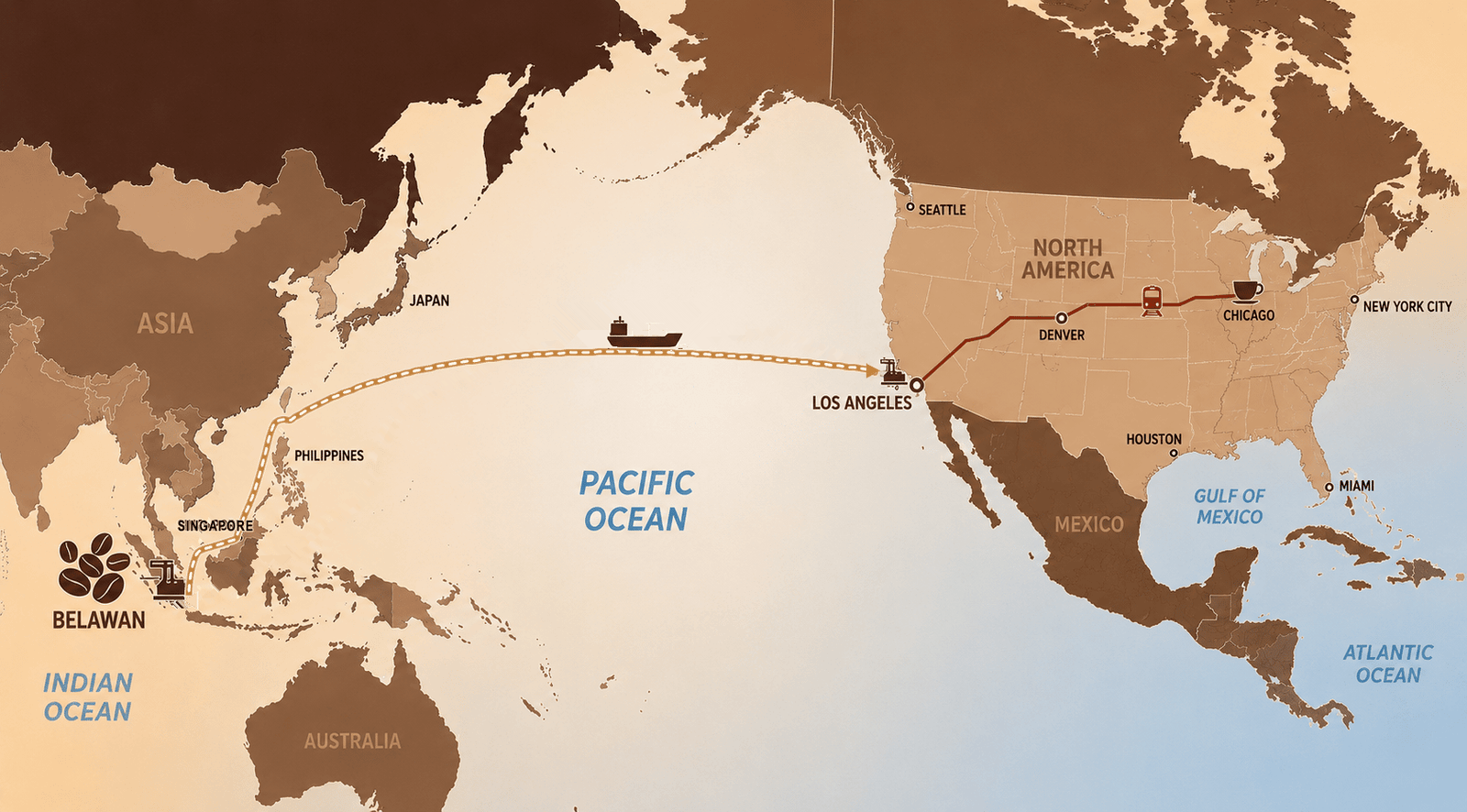
Picture a container of Sumatra headed for a roaster in Chicago.
Beans get bagged in North Sumatra and trucked to Belawan, where they are loaded into a standard 20-foot container: 320 bags of 60 kilos, about 42,000 pounds of green coffee. That box rides a feeder ship to Singapore, transfers to a transpacific mainline vessel, crosses the ocean to Los Angeles / Long Beach, and finishes the last leg to Chicago by rail.
Four to five weeks, door to door.
Why a Pacific route cares about a war in the Gulf
Nothing on that map goes anywhere near the Strait of Hormuz. The box never enters the Gulf, never touches the Red Sea, never comes close to the fighting. So why does a war out there show up on a Sumatra-to-Chicago invoice?
Ships pile up somewhere else. Ocean shipping is one connected system. When vessels reroute around a conflict zone, they do not vanish. They bunch into transshipment hubs like Singapore, queues form, berths fill, and schedules slip on lanes that never went near the war. Capacity tied up sailing the long way around is capacity not serving the Pacific.
Fuel costs more on every route. Bunker prices climbed with crude, and war-risk and other premiums layered on top. Fuel gets burned on every route, not just the disrupted ones.
Carriers price opportunistically. A disruption anywhere is leverage to raise rates everywhere, whether or not your particular container was ever at risk.
Most of the time, ordinary supply and demand sets the cost of moving a box. It takes an external shock, a war or a pandemic, to reveal how little slack there is in global supply chains, and how quickly a problem in one waterway becomes a price increase on the other side of the world.
What the war did to the freight rate
These numbers are ocean and rail freight only, from the Indonesian port to the inland rail ramp in Chicago. Not the coffee itself, not insurance, duties, or last-mile drayage.
In 2025, that move cost about $3,600 per container. In July 2026, with the war and the disruption around Hormuz, the same move ran roughly $9,600. Nearly triple, a jump of about $6,000 per box. On a per-container basis, that hurts.
Spread it across the coffee inside the box and it looks different:
| Per container | Per pound of green coffee | |
|---|---|---|
| Freight, 2025 | $3,600 | 9 cents |
| Freight, July 2026 | $9,600 | 23 cents |
| The increase | +$6,000 | +14 cents |
A war that nearly tripled ocean freight added about 14 cents to a pound of green coffee.
Freight as a share of what green coffee costs
What does a roaster pay for the coffee itself? In July 2026 Genuine Origin, one of the bigger importers, listed Sumatra Mandheling G1 at $6.89 a pound and organic Gayo G1 at $6.99, delivered. Across their full catalogue most lots sat between $5.50 and $8, and rare microlots ran past $16.
Against a bean that costs roughly $7 a pound, a 14-cent freight increase is about 2%. The entire ocean freight bill, at 23 cents, is around 3%.
What that means for a 12-ounce bag
A 12-ounce bag of roasted coffee starts as about 15 ounces of green, because water cooks off in the roast.
- The war's freight increase works out to about 13 cents a bag.
- The entire ocean and rail freight bill, not the increase, the whole thing, is about 21 cents a bag.
Coffee is dense and valuable, and it ships in a small box. That is why even a headline-grabbing freight spike lands as about 13 cents on a bag.
Freight is real, and it went up a lot. It is just not where the money in a bag of coffee lives. The next time a supply-chain headline suggests your coffee is about to get expensive because of ships and chokepoints, remember what moves your cost: the price of the bean itself.
Notes on the numbers
On the freight. $3,600 and $9,600 are market rates for ocean and rail carriage, Indonesian port to inland ramp in Chicago. Spot rates move week to week and vary by carrier, by route, and by the surcharges attached at the time. A roaster on a long-term contract may pay very differently from one buying on the spot market.
On the coffee. Green prices vary enormously by quality, rarity, origin, processing, harvest and lot size. The Sumatra figures above are importer list prices for 65-pound boxes delivered in the US, which means ocean freight, import costs and warehousing are already baked into them. Buy a full container at origin and the per-pound number is lower. Buy a scarce microlot and it is far higher. Whatever you pay, the freight increase moves it by roughly 2%.
On roast loss. After the newsletter version ran, Doug Ilg of Celtic Cup Coffee Roasting in Silver Spring, Maryland, wrote in to point out that it takes about 1.25 pounds of green coffee to make a pound of roasted, because water cooks off in the roast. The per-bag figures here use that ratio, as does the follow-up on the carbon footprint of the same voyage. The newsletter had the increase at about 12 cents and the whole bill at about 19. The conclusion is the same: freight is a small slice of the bag.
Keep reading
- The carbon footprint of shipping coffee: the same container, measured in CO2 instead of dollars.
- Find independent roasters near you, or browse coffee you can buy direct.
- These explainers go out first in What's Brewing, our weekly newsletter.
Frequently Asked Questions
How much does ocean freight add to the price of a bag of coffee? For a 12-ounce bag of Sumatran coffee shipped from Indonesia to Chicago, ocean and rail freight came to about 21 cents in July 2026, when rates were unusually high. That is roughly 3% of the cost of the green coffee.
Did the Gulf war and the Strait of Hormuz disruption make coffee more expensive? It nearly tripled the freight rate on a container from Indonesia to Chicago, from about $3,600 in 2025 to about $9,600 in July 2026. Spread across the coffee in the box, that is about 14 cents per pound of green coffee, or about 13 cents on a 12-ounce bag.
How much coffee fits in a shipping container? A standard 20-foot container of green coffee holds 320 bags of 60 kilos, about 42,000 pounds.
How long does coffee take to ship from Indonesia to the US Midwest? About four to five weeks door to door: truck to the port of Belawan, feeder ship to Singapore, a transpacific vessel to Los Angeles or Long Beach, then rail to Chicago.
What actually drives the price of a bag of coffee? The price of the green coffee itself. In July 2026 importer list prices for Sumatran coffee were around $7 a pound, against about 23 cents a pound for the entire ocean and rail freight bill.
Last updated: September 2026