The Carbon Footprint of Shipping Coffee: About 140 Grams a Bag
First published in our newsletter, What's Brewing, on July 29, 2026.
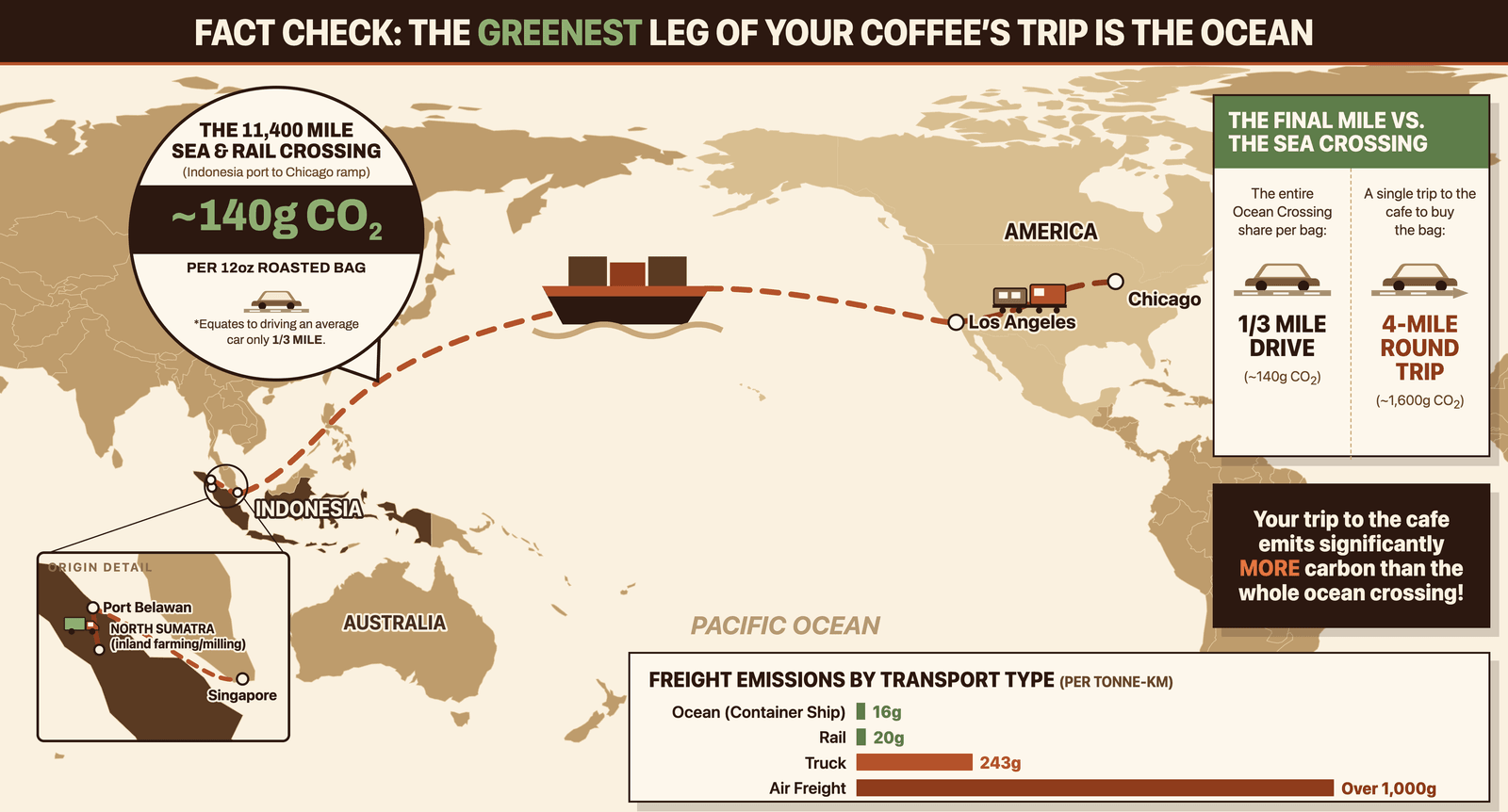
The short answer: carrying a 12-ounce bag's worth of coffee from a port in North Sumatra to a rail yard in Chicago, about 9,200 miles by sea and 2,200 by rail, emits about 140 grams of CO2. That is roughly a third of a mile of driving. The ocean crossing is the greenest leg of your coffee's life.
Shipping coffee halfway around the world feels like it should be the dirty part of the cup. Europe has started taxing shipping for exactly this CO2. The US has not, so a container bound for a roaster here pays nothing for the emissions. Either way, the number is worth knowing.
This is the same container we followed in how much shipping adds to a bag of coffee. Same voyage, different question.
The voyage
42,000 pounds of green coffee in a standard 20-foot container, 320 bags of 60 kilos, trucked to Belawan, loaded onto a feeder ship to Singapore, then roughly 8,000 nautical miles, about 9,200 miles, across the Pacific to Los Angeles, and the last 2,200 miles to Chicago by rail. Four to five weeks, door to door.
Isn't shipping a huge polluter?
In aggregate, yes. Ocean shipping is roughly 3 percent of global CO2, because the world moves an almost unimaginable amount of cargo by sea. Per pound of dense, valuable cargo, though, it is the cleanest long-haul option there is.
| Mode | Grams of CO2 to move one tonne one kilometer |
|---|---|
| Sea | about 16 |
| Rail | 20 |
| Truck | 243 |
| Air | over 1,000 |
A container ship is a slow, enormous, absurdly efficient way to move mass, and your bag's share of its total is tiny.
The CO2 for one container of coffee
Here is the sea and rail carbon for that container, from the Indonesian port to the Chicago rail ramp. Not the farming, not the roast, not the drive home. Just the freight. Because water cooks off in the roast, it is priced per pound of the roasted coffee that ends up in your bag, not the raw green.
| Whole container | Per 12-ounce bag | |
|---|---|---|
| CO2, ocean plus rail | about 6.1 tonnes | about 140 grams |
Nobody is taxing that on this side of the Atlantic. The emissions that add up sit somewhere else: farming and milling at origin, the roast, the packaging, and, more than most people expect, how you brew it at home.
The cup in your hand
Take the roughly 20 grams of roasted coffee in a single brewed cup. It takes about 1.25 pounds of green to make a pound of roasted, so that cup started life as roughly 25 grams of green beans loaded into the container in Sumatra. The ocean and rail freight to carry those 25 grams to Chicago works out to about 8 grams of CO2.
Now drive to the cafe to buy it. Two miles there, two miles back. A typical gasoline car emits about 400 grams of CO2 per mile, so that four-mile round trip is roughly 1,600 grams. The quick hop to pick up your coffee out-pollutes the ocean crossing of the beans in your cup by something like 200 to 1. Even boiling the water to brew that one cup, somewhere around 20 grams on a typical grid, beats the freight.
The thing that traveled 11,000 miles is the smallest number in the cup.
For importers: inset it, do not offset it
If you bring in your own green and want to do something about that freight carbon, the cleaner move is insetting, not offsetting.
Offsetting pays for a reduction somewhere unrelated, a tree planted to cancel a tonne burned at sea. Insetting pays for the reduction inside shipping itself. You fund sustainable marine biofuel, usually made from waste like used cooking oil, or green methanol, to be burned in the network in place of fossil bunker fuel.
A book-and-claim system lets you claim that verified cut even though the fuel went into a different ship than the one carrying your box, and the credit is retired so nobody counts it twice. Waste-based biofuel cuts well-to-wake CO2 by roughly 80 percent against heavy fuel oil, and carriers like Maersk now sell it by the container. Because your bag's share of the crossing is already so small, insetting the entire ocean leg comes to a fraction of a cent a bag. It is the honest version of a green claim: real fuel, a real reduction, inside the supply chain that made the emissions.
A correction from a roaster
Doug Ilg, owner and roast master at Celtic Cup Coffee Roasting in Silver Spring, Maryland, wrote in after the freight piece with a good catch. It takes about 1.25 pounds of green to make a pound of roasted coffee, because water cooks off in the roast. The per-bag figures here are priced on the roasted coffee in your bag from the start. Thanks, Doug.
Notes on the numbers
This is sea and rail freight only, and the intensities used are industry averages. The car and kettle comparisons are round estimates that swing with the vehicle and your local grid. Carbon pricing is left out.
Sources
- Climate Action Accelerator, freight carbon intensity by transport mode
- US EPA, greenhouse gas emissions from a typical passenger vehicle
- The Guardian, carbon footprint of a cup of tea or coffee
- Maersk ECO Delivery, biofuel and methanol emissions reductions
- Global Maritime Forum, book-and-claim chain of custody
Keep reading
- How much does shipping add to a bag of coffee? The same container, measured in dollars.
- Find independent roasters near you.
- These explainers go out first in What's Brewing, our weekly newsletter.
Frequently Asked Questions
What is the carbon footprint of shipping a bag of coffee? For a 12-ounce bag carried from North Sumatra to Chicago by sea and rail, about 140 grams of CO2, roughly a third of a mile of driving. A whole 20-foot container comes to about 6.1 tonnes.
Is ocean shipping bad for the environment? In aggregate it is roughly 3 percent of global CO2. Per tonne of cargo it is the cleanest long-haul option: about 16 grams of CO2 per tonne-kilometer by sea, against 20 by rail, 243 by truck, and over 1,000 by air.
How much CO2 does shipping add to one cup of coffee? About 8 grams for the roughly 25 grams of green coffee behind one brewed cup. A four-mile round trip to a cafe in a typical gasoline car is roughly 1,600 grams.
What is insetting, and how is it different from offsetting? Offsetting pays for an emissions reduction somewhere unrelated. Insetting pays for a reduction inside the same supply chain, for example funding waste-based marine biofuel burned in place of fossil bunker fuel, claimed through a book-and-claim system.
Where are the biggest emissions in a cup of coffee? Not in the ocean crossing. They sit in farming and milling at origin, the roast, the packaging, and how the coffee is brewed at home.
Last updated: September 2026