America's Most Caffeinated States: Indie Coffee Roasters Per Capita
Updated September 2026. We re-ran the ranking with the current directory (more than 4,600 roasters, up from about 4,000 in July) and the Census Bureau's latest state population estimates. The original July version used 2020 Census counts. The shape of the list held. A few places in it moved.
When people talk about American coffee, they talk about the same handful of places. Portland. Seattle. Brooklyn. The Bay Area. And by raw numbers that reputation holds up: California, Texas, Washington, and New York carry the biggest raw benches in the country.
But raw counts mostly measure how many people live somewhere. California has the most roasters because California has the most everyone. The more interesting question is per person. If you dropped into a random state, where are your odds of a great local roaster actually highest?
We mapped every active independent roaster in our directory, more than 4,600 across the 50 states, and divided by the latest Census Bureau population estimates. The ranking that fell out is not the one the coffee press would predict.
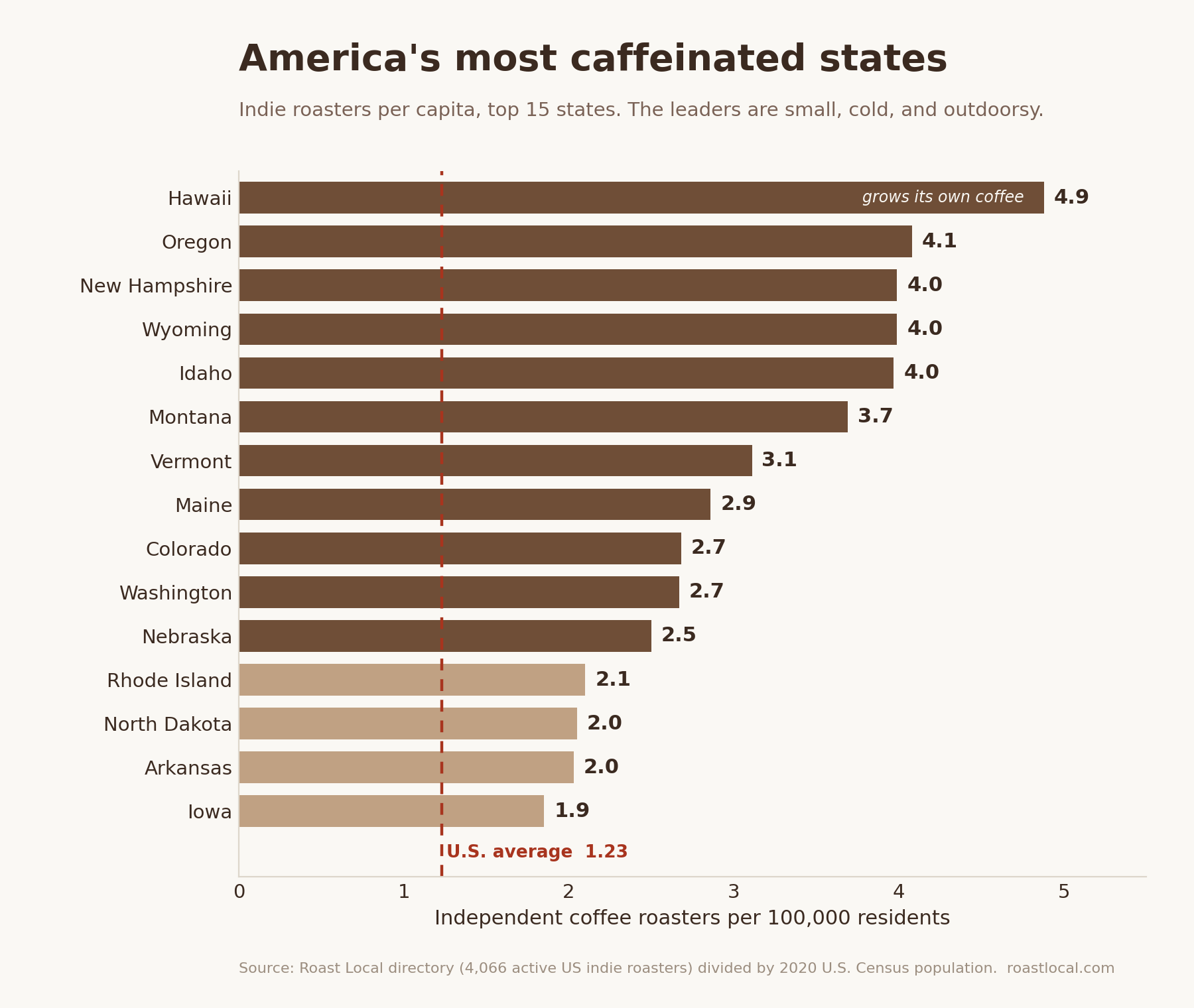
The leaders are small, cold, and outdoorsy
Nationally there are about 1.35 independent roasters for every 100,000 Americans. The states at the top of the list clear that bar roughly three times over, and almost none of them are places anyone calls a coffee capital.
Hawaii tops the list at 5.4 roasters per 100,000, but Hawaii is a special case: it is the only US state that grows coffee commercially, so a chunk of its roasters are also farmers. Set it aside and the real story starts at number two.
Oregon comes in at 4.2 per 100,000, which is the number you would expect from the state that helped invent American third-wave coffee. But Oregon does not get the spot to itself. New Hampshire is also at 4.2, and ahead by a hair if you carry the decimals out. Montana is at 4.1. Vermont is at 4.0. Wyoming is at 3.9 and Idaho at 3.7. Nobody puts any of those five on a coffee list. Then the numbers drop off a ledge: South Dakota is next at 2.9, and Maine follows at 2.8.
Wyoming is the one that stops people. It is the least-populated state in the country, and it has one independent roaster for roughly every 26,000 residents. That is a denser indie coffee scene, per person, than New York or California. A state most people picture as cattle and open range is quietly a notably caffeinated place in America.
The pattern is hard to miss once you see it. The per-capita leaders are the Mountain West (Wyoming, Idaho, Montana, Colorado), the Pacific Northwest (Oregon, Washington), and northern New England (New Hampshire, Vermont, Maine). Small populations. Cold winters. Mountains. Outdoor-recreation economies and college towns. Coffee, it turns out, is a cold-weather, tight-community, third-place kind of business, and it thrives in exactly those conditions whether or not anyone is writing about it.
The reputation gap
Here is the part that reorders the map. The states everyone thinks of as coffee capitals are, per person, thoroughly average.
California sits at 1.36 per 100,000, right on the national line. New York is at 0.99, below it. Their absolute scenes are enormous, and their best roasters are as good as any in the world, but spread across tens of millions of people, the density thins out fast. Reputation is built by the top of the scene. Per-capita density is built by the whole thing.
Where the coffee deserts really are
The bottom of the list is just as telling as the top. The least-caffeinated states by this measure are big, populous, and mostly warm:
Florida is last at 0.80 roasters per 100,000. Texas (0.85), Maryland (0.88), Alabama (0.92), and New York (0.99) round out the bottom, with New Jersey a rounding error behind New York. Oregon and New Hampshire each have more than five times the per-capita roaster density of Florida.
That does not mean these states lack good coffee. Florida has a deep Cuban coffee tradition and real specialty operators in Miami and Orlando. Texas has the second-largest raw bench in the country. But relative to how many people live there, the independent-roasting layer is thin, which is another way of saying there is room. If you are a roaster wondering where the market is least saturated, the bottom of this list is your answer more than the top is.
How we measured this
The roaster counts are every active independent roaster in the Roast Local directory as of September 2026, one per business, corporate-owned and acquired brands excluded. Population is the US Census Bureau's July 1, 2025 state estimates, the most recent available. Per-capita figures are roasters per 100,000 residents. The District of Columbia is left out of the ranking because it is a city, not a state.
The first version of this post, in July 2026, used 2020 Census counts. We switched because six years of growth matters at this resolution: Idaho has added about a tenth of its population since 2020 and Florida nearly as much, and that alone is enough to move a state a couple of places.
One honest caveat: a directory is a sample, not a census of coffee. Our coverage is deepest in the regions we have been cataloging longest, which skews toward the West, so the Mountain West and Pacific Northwest numbers may run slightly high relative to states we are still filling in. The states packed together near the top are separated by a roaster or two each, so read them as a group, not a podium. We keep closing the coverage gap, and the broad shape of the ranking, cold small states up top and big warm states at the bottom, has held across both runs.
Find the roasters near you
Every roaster behind these numbers is on the map. Browse by state to see your own, or start with the surprising ones: Wyoming, Montana, and Vermont punch so far above their weight that they are worth a scroll even if you will never visit.
Frequently Asked Questions
Which US state has the most coffee roasters per capita? Excluding Hawaii, which grows its own coffee and is a special case, New Hampshire and Oregon lead at about 4.2 independent roasters per 100,000 residents, followed by Montana at 4.1, Vermont at 4.0, Wyoming at 3.9, and Idaho at 3.7. The national average is 1.35 per 100,000.
Why does Wyoming have so many coffee roasters per capita? Wyoming is the least-populated US state, so even a modest number of roasters (23) produces a high per-person density. The pattern holds across the Mountain West: small populations, outdoor-recreation economies, and tight communities support more independent coffee per person than big cities do.
Which states have the fewest coffee roasters per capita? Florida ranks last at 0.80 roasters per 100,000 residents, followed by Texas, Maryland, Alabama, and New York. These are populous states where the independent-roasting layer is thin relative to population, not places without any good coffee.
Isn't California or New York the coffee capital of America? By raw count, yes. California has the most independent roasters of any state. But per person, California (1.36 per 100,000) and New York (0.99) are average to below average. Their scenes are large because their populations are large.
Last updated: September 2026